



International Institute of Digital Medical Technologies and Artificial Intelligence
The International Institute of Digital Medical Technologies and Artificial Intelligence was established in 2025 as part of the Kazakh-Russian Medical University. The opening of the institute was a continuation of the university's research and practical activities, which include developing and implementing advanced practices and tools to improve the quality of medical care, increase its accessibility, and support regional (governmental) programs for preserving and promoting public health.
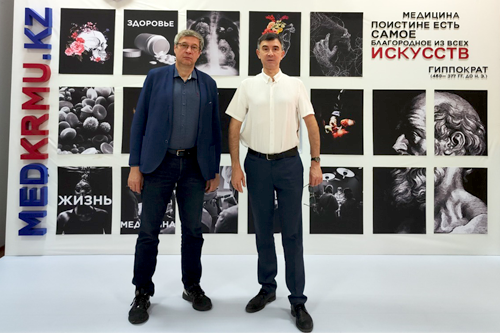
The initiative of Rector Dzhainakbayev Nurlan Temirbekovich to create the Institute was born during the visit to Kazakhstan in September 2025 by Andrey Alexandrovich Almazov, Director of Project Activities at the National Medical Knowledge Association (www.nbmz.ru), and Sergey Anatolyevich Anufriev, Director of the St. Petersburg Medical Forum (www.medforumspb.ru).
Mission of the Institute
The mission of the International Institute for Digital Transformation and Artificial Intelligence in Healthcare is to preserve and improve public health through the transfer of breakthrough, innovative digital transformation and artificial intelligence technologies in healthcare.
Our goal is not only to improve the healthcare system, but also to promote the sustainable development of medical clinics in a changing environment.
The Institute operates:
- Laboratory of Artificial Intelligence and Innovative Technologies;;
- Center for the Implementation of Innovative Technologies in Practical Healthcare;
- Center for Management and Transfer of medical knowledge (medical knowledge management).
The Institute is a catalyst and an active actor in the implementation of innovative approaches and modern technologies, creating a more efficient and accessible healthcare system and helping to significantly improve the performance of medical clinics of various forms of ownership. Our values and priorities.
Management of medical knowledge and its transfer to digital healthcare
Center for Management and Transfer of medical knowledge (medical knowledge management).
Medical knowledge is generated by the synergy of three sources: medical literature (monographs, trusted medical information databases such as clinical protocols, publications, conference presentations aggregated in specialized knowledge databases, etc.), the experience of medical professionals (clinicians, medical scientists), and the practice of using RWD/RWE (Real World Data/Evidence), which has become possible thanks to the use of information technology. All three sources are interconnected, and clinical practice is documented in publications, but it is often impossible to transfer practical experience and knowledge without interaction with a mentor. We offer a comprehensive educational product and continue to develop a machine-readable database of clinical knowledge (medical ontologies) that can be used in medical information systems.
How does it work?
Doctors are trained in medical advanced training courses or receive basic education at the Kazakh-Russian Medical University. As part of their basic or additional professional education, they are offered author's courses on specific, most in-demand nosologies, which include practical sessions (master classes) and, most importantly, further support from a mentor, both in the form of doctor-to-doctor communication and in the form of a medical council, with the ability to connect directly to the patient's medical history and current clinical case. In this way, the mentor doctor can remotely supervise the patient treatment of the trainee doctor, and the trainee doctor also receives an innovative tool for interacting with the patient in addition to in-person appointments. The tool includes AI agents and assistants to provide guidance to doctors and manage patients, as well as access to a medical knowledge base that can be integrated with other healthcare information systems (HIS).
Our values and priorities:
All of the Institute's activities are aimed at creating a more efficient and accessible healthcare system, which will lead to improved public health and increased quality of life for citizens of Kazakhstan and other countries.
- Strengthening public trust in the healthcare system as a whole by implementing international standards in routine practice, ensuring a high level of accessibility, safety, and quality of medical care.
- The focus on digitalization and the introduction of new technologies, such as artificial intelligence and electronic medical records, reduces waiting times and simplifies access to medical care, ensuring its high quality and safety, including for patients in remote and hard-to-reach areas. These technologies enhance the capabilities of medical professionals and support the efficiency of healthcare organizations and the overall healthcare system.
- Ensuring the high level of medical staff qualifications in the field of digital technologies and artificial intelligence is critical for improving the quality of medical services in the 21st century. Education and training of specialists lead to a higher level of professionalism and responsibility among healthcare workers, which directly affects the outcomes of treatment and patient satisfaction.
- Preventive medicine, disease prevention, and public health. The implementation of proactive programs and technologies for remote health monitoring helps to reduce the incidence of diseases and improve overall public health, thereby reducing the burden on the healthcare system.
- Assistance in the development of public-private partnerships and the private healthcare market. Improving the quality of medical services and introducing innovative technologies will make clinics more competitive in the regional market, attracting more patients from other countries and increasing their financial stability.